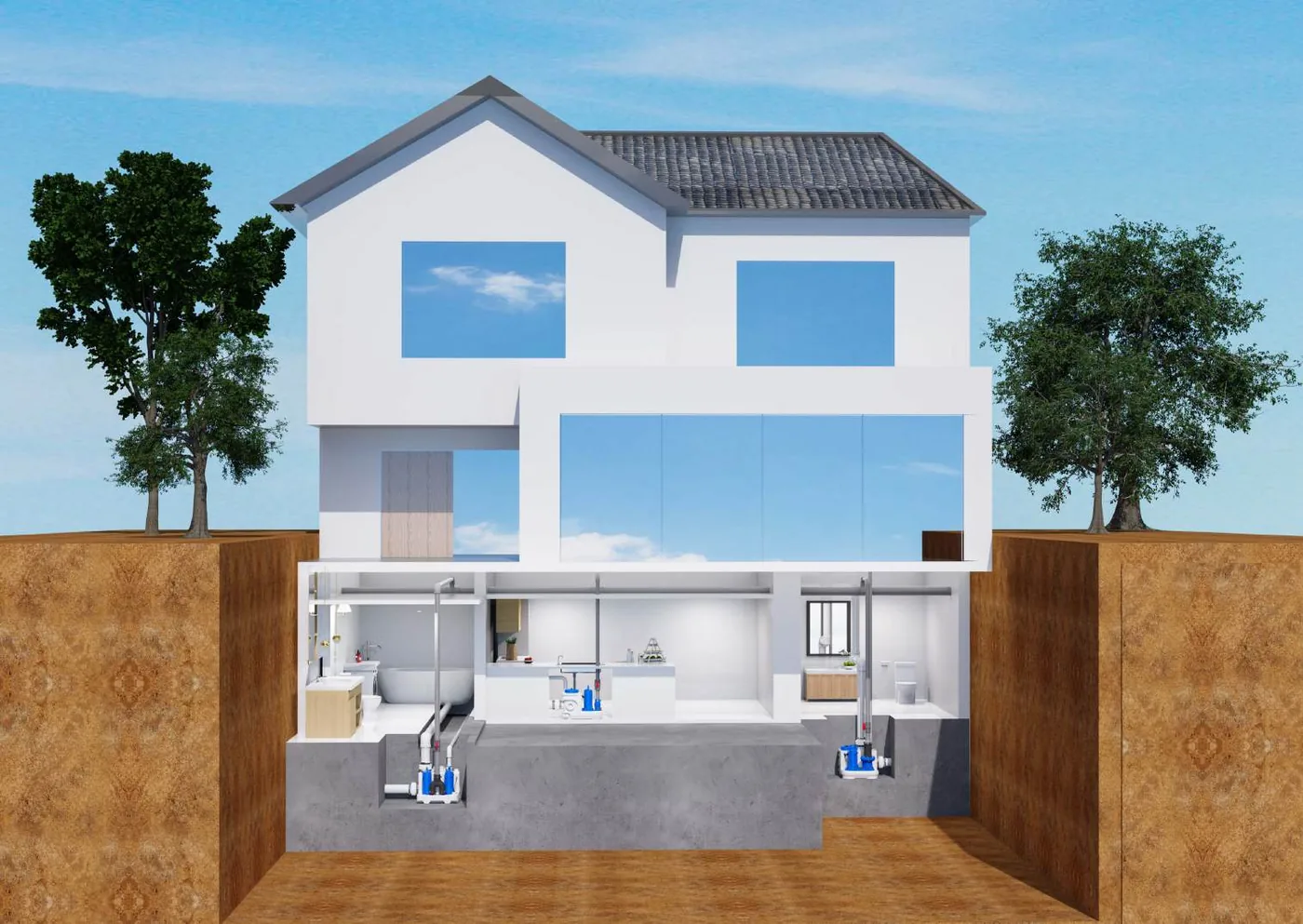
When a lifting station is required
Building drainage works by gravity. The moment a fixture sits below the invert of the public sewer — or below the backflow level recognised in the local code — gravity stops being an option and the wastewater has to be lifted mechanically.
That situation is far more common than it used to be. Basements are now finished space rather than storage: guest bathrooms, utility rooms, home gyms and cinema rooms all generate wastewater at a level the sewer cannot accept. The same applies to commercial fit-outs, where a kitchen or washroom is placed wherever the floor plan allows rather than wherever the drainage happens to run.
A lifting station resolves it in a single sealed unit. Wastewater enters the collecting tank under gravity over a short run, the integrated pump starts on level, and the contents are discharged upward through a rising main into the gravity drain above. Nothing is visible outside the unit, and nothing is left open to the room.
If wastewater cannot run to the sewer under gravity across the whole route — not just the first few metres — a lifting station is required. A long horizontal run that would need an unachievable gradient has the same answer.
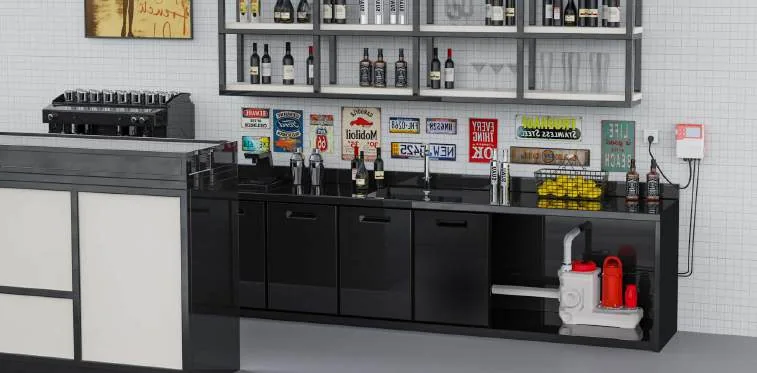
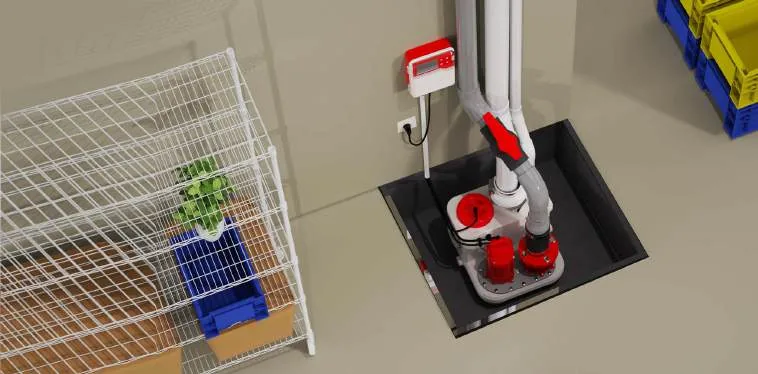
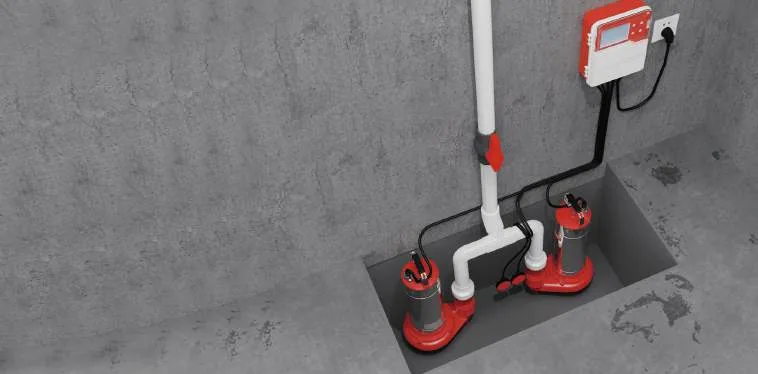
Where these units are installed
The range covers domestic and light commercial duty. The configurations differ mainly in tank volume, number of pumps and discharge size; the application decides which is appropriate.
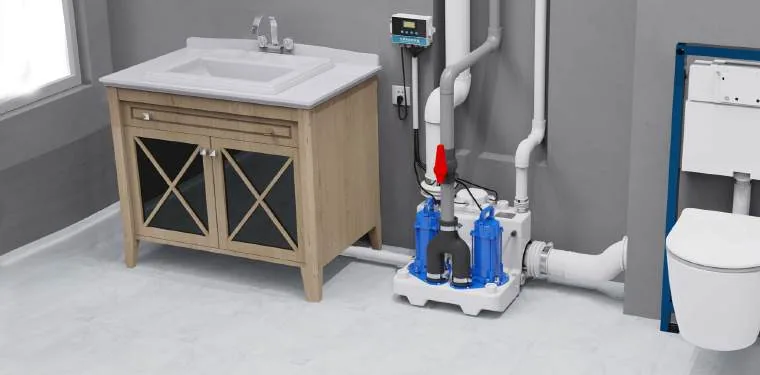
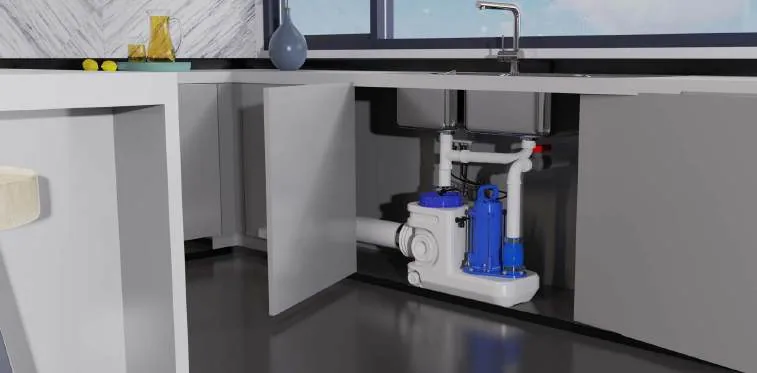
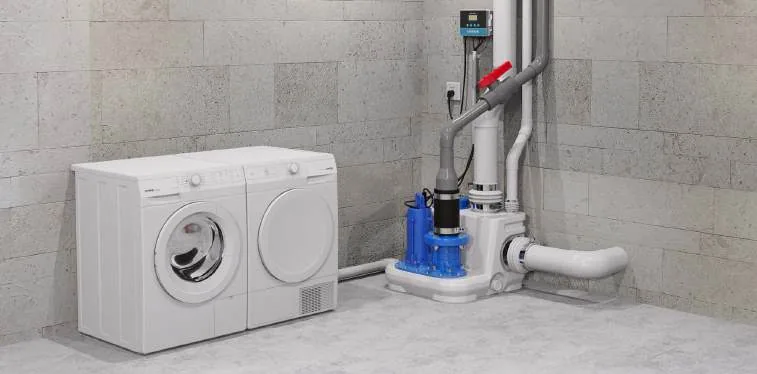
Configurations
Four classes cover the range. Within each class the tank volume, motor rating and discharge diameter vary; the figures below are the span across that class rather than a single unit.
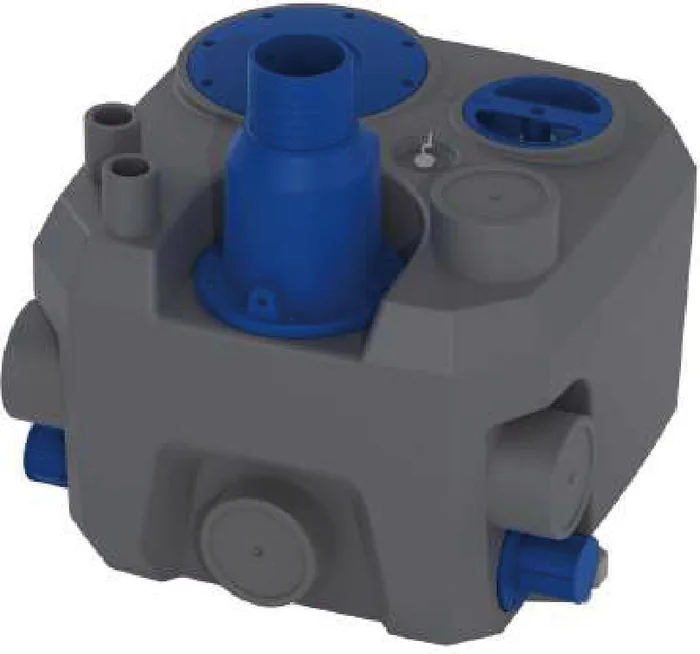
Compact single-pump — 20 to 30 L
The smallest footprint in the range, for a single bathroom or a kitchen run. Fits under a vanity unit or inside a standard cabinet. Pneumatic level switching on most variants, which keeps the control gear out of the wetted path.
| Tank volume | 20 – 30 L |
| Motor rating | 1.1 – 1.5 kW, single pump |
| Max flow | 14 – 23 m³/h |
| Max head | 10 – 13.5 m |
| Inlets | DN110 × 3, DN50 × 5–8 |
| Discharge | DN50 / DN60 |
| Weight | 19 – 28 kg |
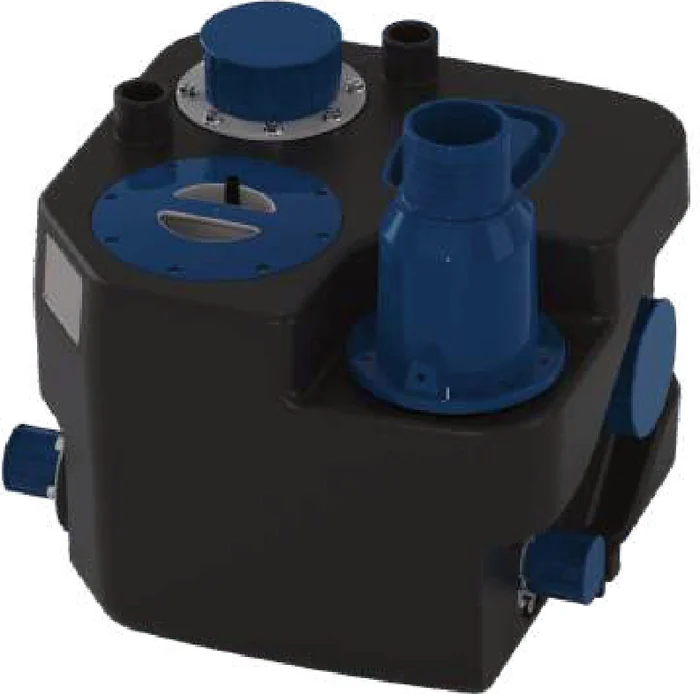
Standard single-pump — 40 to 60 L
The general-purpose size for a complete bathroom group or a small commercial fit-out. The larger tank gives more buffer between pump starts, which matters where inflow is irregular. DN90 discharge on most variants.
| Tank volume | 40 – 60 L |
| Motor rating | 1.1 – 1.5 kW, single pump |
| Max flow | 26 – 38 m³/h |
| Max head | 13 – 16 m |
| Inlets | DN110 × 4–5, DN50 × 5–6 |
| Discharge | DN50 / DN90 |
| Weight | 30 – 32 kg |
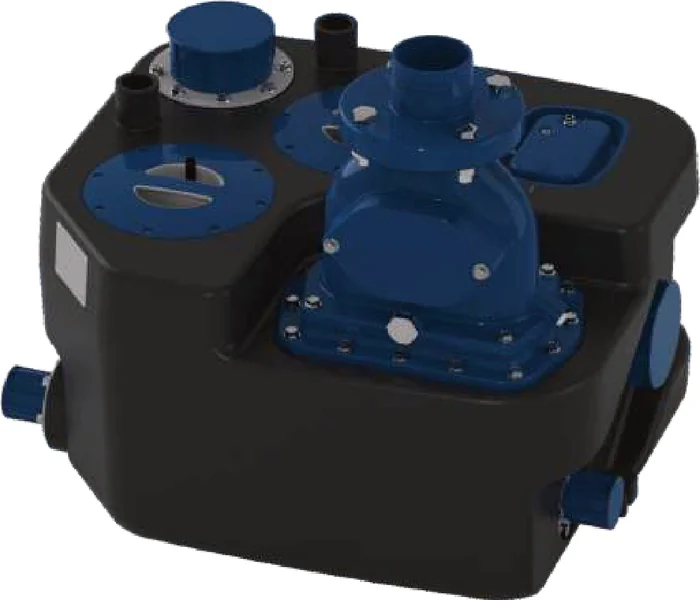
Twin-pump duty/standby — 60 to 100 L
Two pumps in one tank, alternating on duty and both available at peak inflow. The standby pump takes over automatically if the duty pump is unavailable. This is the configuration to specify wherever a stoppage would flood occupied space, or where the unit serves more than one dwelling.
| Tank volume | 60 – 100 L |
| Motor rating | 1.1 – 1.5 kW × 2 |
| Max flow | 30 – 48 m³/h |
| Max head | 13 – 16 m |
| Inlets | DN110 × 4–6, DN50 × 4–6 |
| Discharge | DN90 |
| Weight | 41 – 83 kg |
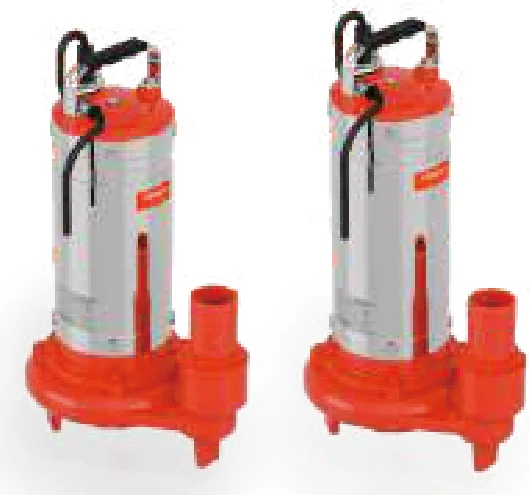
Pit-mounted submersible sets
Where there is an existing sump or a formed floor pit, free-standing submersible pumps on an auto-coupling are often the better answer than a packaged tank. Supplied as single or duty/standby pairs with float switching and a 10 m cable.
| Motor rating | 1.1 kW / 1.5 kW |
| Max flow | 7 – 9 m³/h |
| Max head | 12 – 16 m |
| Discharge | DN50 |
| Solids | 40 mm |
| Cable | 10 m |
Common technical specification
These characteristics are shared across the packaged range.
| Collecting tank | HDPE, sealed and odour-tight |
| Motor protection | IP68, continuously submersible |
| Liquid temperature | 45 °C continuous, 65 °C for up to 10 minutes |
| Ambient temperature | 45 °C maximum |
| Solids handling | 40 mm standard, 65 mm on selected models |
| Power supply | 220–240 V, 50 Hz, single phase |
| Speed | 2800 rpm |
| Level switching | Float switch or pneumatic switch, by configuration |
| Vent connection | DN50, to be taken to atmosphere |
| Power cable | 3.5 – 5 m |
| Start level | 10 – 20 cm above tank base |

Selecting the right unit
Installation requirements
These are packaged units and most of the work is pipework rather than plant, but four points decide whether the installation performs.
- Venting is not optional. The DN50 vent must be carried to atmosphere. A sealed tank without a vent cannot fill or discharge properly and will draw traps.
- Fit a non-return valve and an isolating valve in the rising main, both accessible. Without the non-return valve the main drains back into the tank on every stop and the pump short-cycles.
- Keep the inlet run short and falling. The gravity section into the tank should be as short as the layout allows, with continuous fall and no dips.
- Retain access. The cover must be removable in situ. Units boxed into cabinetry without an access panel become a demolition job at the first service.
Building drainage requirements differ substantially by country. Wastewater lifting plants installed in buildings within the EU fall under the Construction Products Regulation and the EN 12050 series of harmonised standards, with separate parts covering faecal and faecal-free duty. Technical datasheets, dimensional drawings, performance curves and installation instructions are supplied for every configuration, and conformity documentation is confirmed against the destination market before any order is placed. Tell us the country of installation at enquiry stage and we will set out exactly what applies.
Supply and lead times
These units are supplied directly, not through a distribution chain, which keeps both the price and the lead time under our control. Quotations go out within 24 hours of a complete enquiry. Stock positions and shipping times vary by configuration and destination, and we confirm both in writing before you commit.
We supply across Europe, the Middle East, North America, Asia-Pacific and Latin America. For pricing we need the fixture list, the lift height, the rising main details and the delivery country.
Frequently asked questions
What is a sewage lifting station?
A sewage lifting station is a sealed collecting tank with one or more integrated pumps that receives wastewater from fixtures located below the level of the public sewer, then pumps it up to the gravity drain. It is used wherever natural fall is not available - basement bathrooms, sunken kitchens, underground car parks and converted cellars.
When do I need a lifting station instead of a normal drain?
Whenever the fixture discharge sits below the sewer invert or below the recognised backflow level. If wastewater cannot run to the sewer under gravity across the whole route, it has to be lifted. A lifting station is also used where a long horizontal run would otherwise need an impractical gradient.
What is the difference between a single-pump and a twin-pump station?
A single-pump station handles one duty and stops if the pump is unavailable. A twin-pump station runs duty/standby: the second pump takes over automatically on failure and both can run together at peak inflow. Twin-pump units are normally specified where a stoppage would flood occupied space, or where the installation serves more than a single dwelling.
What flow rate and head do I need?
Flow is driven by the number and type of connected fixtures; head is the vertical lift from the tank to the discharge point plus friction losses in the rising main. Units in this range deliver up to 48 cubic metres per hour and up to 16 m of head. Send the fixture list, the lift height and the pipe run and we will size it.
Can these stations handle toilet discharge and solids?
Yes. The units are built for black water as well as greywater and pass solids up to 40 mm as standard, with 65 mm on selected larger models. Specify the application when requesting a quotation, because faecal and faecal-free duties are specified differently in most national codes.
What pipe connections do the tanks take?
Inlets are DN110 and DN50 in multiple positions so the unit can be rotated to suit the room. Discharge is DN50, DN60 or DN90 depending on model. Each unit also carries a DN50 vent connection, which must be taken to atmosphere.
How noisy are they, and where can they be installed?
The pumps are submerged in the tank, which absorbs most of the operating noise, and the tanks are sealed and odour-tight. They are routinely installed in occupied spaces - under vanity units, behind kitchen cabinetry, in plant cupboards or recessed into a floor pit. Access for maintenance must be retained.
What documentation is supplied with the units?
Technical datasheets, dimensional drawings, performance curves and installation instructions are provided for every configuration. Certification and conformity documentation is confirmed per market and per project before order, since building drainage requirements differ by country.